

Short Communication
Effectiveness of Structured Nursing Interventions on Postoperative Pain Management Among Surgical Patients
1Assistant Professor, Department of Medical Surgical Nursing, Shree Siddeshwara Samsthe College of Nursing, Vijayapur, Karnataka, India.
2Assistant Professor, Department of Child health Nursing, Shree Siddeshwara Samsthe College of Nursing, Vijayapur, Karnataka, India.
3Assistant Professor, Dept of Medical Surgical Nursing, SDS TRC and RGICD College of Nursing Bengaluru, Karnataka, India.
4Assistant Professor, Department of Community Health Nursing, Shree Siddeshwara Samsthe College of Nursing, Vijayapur, Karnataka, India.
*Corresponding Author: Renuka Bhajantri, Assistant Professor, Department of Medical Surgical Nursing, Shree Siddeshwara Samsthe College of Nursing, Vijayapur, Karnataka, India.
Citation: Bhajantri R, Loni S, Ananda, Ranagatti S. (2026). Effectiveness of Structured Nursing Interventions on Postoperative Pain Management Among Surgical Patients, International Clinical and Medical Case Reports, BioRes Scientia Publishers. 5(2):1-9. DOI: 10.59657/2837-5998.brs.26.062
Copyright: © 2026 Renuka Bhajantri, this is an open-access article distributed under the terms of the Creative Commons Attribution License, which permits unrestricted use, distribution, and reproduction in any medium, provided the original author and source are credited.
Received: March 02, 2026 | Accepted: March 13, 2026 | Published: March 19, 2026
Abstract
Postoperative pain is one of the most common complications following surgical procedures and can negatively affect recovery, mobility, and overall patient satisfaction. Effective pain management is therefore an essential component of postoperative nursing care. This study aimed to evaluate the effectiveness of structured nursing interventions on postoperative pain management among surgical patients. A quasi-experimental study design was adopted involving 100 postoperative patients admitted to a tertiary care hospital. Participants were divided into experimental (n=50) and control (n=50) groups. The experimental group received structured nursing interventions including pain assessment using the Numeric Rating Scale (NRS), positioning, relaxation techniques, early ambulation guidance, and patient education. The control group received routine care. Pain levels were assessed at 6, 12, 24, and 48 hours after surgery. Results showed that the mean pain score decreased significantly in the experimental group (7.1 to 2.8) compared with the control group (7.0 to 4.6). The findings indicate that structured nursing interventions significantly reduce postoperative pain and improve recovery outcomes. The study highlights the importance of implementing evidence-based nursing interventions in surgical wards to enhance patient comfort and recovery.
Keywords: postoperative pain; nursing intervention; surgical patients; pain management; postoperative care
Introduction
Postoperative pain is a major clinical problem that affects a large proportion of surgical patients worldwide. Inadequate pain management can lead to complications such as delayed wound healing, respiratory problems, increased stress response, prolonged hospital stay, and reduced patient satisfaction.
Pain after surgery occurs due to tissue injury, inflammatory responses, and activation of the sympathetic nervous system. If pain is not adequately managed, it may result in physiological disturbances such as increased heart rate, impaired respiratory function, and delayed mobilization.
Nurses play a central role in postoperative pain management because they continuously monitor patients and implement both pharmacological and non-pharmacological interventions. Multimodal approaches such as analgesic administration, relaxation therapy, patient education, positioning, and early ambulation are recommended to improve pain control and recovery outcomes.
Structured nursing interventions have been shown to improve postoperative outcomes by combining systematic pain assessment with individualized patient care. Evidence suggests that patient education and non-pharmacological strategies can significantly reduce postoperative pain levels and improve functional recovery.
However, in many clinical settings pain assessment and documentation are inconsistent, which may limit effective pain management.
Therefore, this study aimed to evaluate the effectiveness of structured nursing interventions on postoperative pain management among surgical patients.
Objectives
Primary Objective
To evaluate the effectiveness of structured nursing interventions on postoperative pain among surgical patients.
Secondary Objectives
- To assess the level of postoperative pain among surgical patients in experimental and control groups.
- To compare the pain levels between experimental and control groups after intervention.
- To determine the association between postoperative pain levels and selected demographic variables.
Hypothesis
H1: There will be a significant reduction in postoperative pain scores among patients who receive structured nursing interventions compared with those receiving routine care.
Materials and Methods
Research Design
Quasi-experimental pretest-posttest control group design.
Setting
Surgical wards of a tertiary care hospital.
Sample Size
100 postoperative patients.
| Group | Sample |
| Experimental Group | 50 |
| Control Group | 50 |
Sampling Technique
Convenience sampling.
Inclusion Criteria
- Patients aged 18-65 years
- Patients undergoing abdominal or orthopedic surgery
- Patients able to communicate pain level
Exclusion Criteria
- Patients with cognitive impairment
- Patients admitted to ICU after surgery
Intervention (Structured Nursing Intervention)
The experimental group received:
- Pain assessment using Numeric Rating Scale (0-10)
- Positioning for comfort
- Deep breathing and relaxation exercises
- Early ambulation guidance
- Patient education on pain control
- Cold/heat therapy where appropriate
Control group received routine postoperative care.
Data Collection Tool
Section A
Demographic data:
- Age
- Gender
- Type of surgery
- Duration of surgery
Section B
Numeric Rating Scale (0–10) for pain assessment.
| Score | Interpretation |
| 0 | No pain |
| 1-3 | Mild pain |
| 4-6 | Moderate pain |
| 7-10 | Severe pain |
Results
Table 1: Demographic Characteristics.
| Variable | Experimental (n=50) | Control (n=50) |
| Age 18-30 | 12 | 10 |
| Age 31-45 | 18 | 20 |
| Age 46-60 | 14 | 13 |
| Age >60 | 6 | 7 |
| Male | 28 | 26 |
| Female | 22 | 24 |
Table 2: Mean Pain Score Comparison.
| Time | Experimental Mean ± SD | Control Mean ± SD |
| 6 hours | 7.1 ±1.2 | 7.0 ±1.3 |
| 12 hours | 5.8 ±1.1 | 6.4 ±1.2 |
| 24 hours | 4.1 ±1.0 | 5.5 ±1.1 |
| 48 hours | 2.8 ±0.9 | 4.6 ±1.0 |
Table 3: Pain Level Distribution at 48 Hours.
| Pain Level | Experimental | Control |
| Mild | 35 | 18 |
| Moderate | 12 | 24 |
| Severe | 3 | 8 |
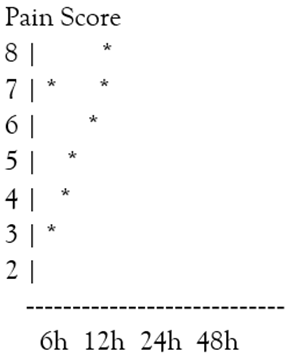
Figure 1: Mean Pain Score Trend.
Experimental group shows a steeper decline in pain score compared to control group.
Discussion
The findings of the present study revealed that structured nursing interventions significantly reduced postoperative pain among surgical patients. The mean pain score decreased from 7.1 to 2.8 in the experimental group compared with 7.0 to 4.6 in the control group.
These findings are consistent with previous research demonstrating that evidence-based nursing practices can significantly reduce postoperative pain and improve patient recovery outcomes.
Similarly, systematic reviews have reported that nursing educational interventions and non-pharmacological approaches such as relaxation techniques and patient education can reduce postoperative pain and anxiety.
Structured pain management protocols that include regular assessment and individualized care have also been shown to improve patient comfort and functional recovery after surgery.
Thus, the integration of structured nursing interventions into postoperative care protocols is essential for improving surgical patient outcomes.
Conclusion
The study concluded that structured nursing interventions are effective in reducing postoperative pain among surgical patients. Patients who received structured nursing care demonstrated significantly lower pain scores compared with those receiving routine care. Implementing systematic pain assessment, patient education, relaxation techniques, and early mobilization can improve postoperative recovery and patient satisfaction.
Implications for Nursing Practice
- Implementation of standardized pain assessment tools.
- Integration of non-pharmacological interventions.
- Training nurses in structured pain management protocols.
- Improving documentation of pain management practices.
Limitations
- Small sample size.
- Conducted in a single hospital.
- Short follow-up period.
Recommendations
- Conduct multicenter randomized controlled trials.
- Explore technology-assisted pain monitoring systems.
- Evaluate long-term recovery outcomes.
References
- Mayhob, M. M., Elsalam, M. A. (2023). Effect of Implementing Evidence Based Nursing Practices on Reducing Postoperative Pain among Patients Undergoing Abdominal Surgery. American Journal of Nursing Research, 11(1):1-11.
Publisher | Google Scholor - Reaza-Alarcón, A., Rodríguez-Martín, B. (2019). Effectiveness of Nursing Educational Interventions in Managing Post-Surgical Pain. Systematic Review. Investigacion y educacion en enfermeria, 37(2).
Publisher | Google Scholor - Crowe, L., Chang, A., Fraser, J. A., Gaskill, D., Nash, R., et al. (2008). Systematic Review of The Effectiveness of Nursing Interventions in Reducing or Relieving Post-Operative Pain. International Journal of Evidence‐Based Healthcare, 6(4):396-430.
Publisher | Google Scholor - Mensah, S. (2025). Optimizing Pain Management Strategies in Postoperative Surgical Patients: A Nursing Perspective. Journal of Medicine and Surgical Nursing, 2(1):38-44.
Publisher | Google Scholor - An, J., An, X., Li, B. (2026). Best Evidence Summary for Postoperative Pain Management in Adult ICU Patients. Journal of Pain Research, 576541.
Publisher | Google Scholor