
Research Article
Awareness About Eye Donation Among Non-Medical Population in Tehri Garhwal: A Cross-Sectional Study
1 Assistant Professor, Department of Optometry, UPUMS, Saifai, Etawah, Uttar Pradesh, India.
2 Assistant Professor, Department of Optometry, Sanskriti University, Mathura, Uttar Pradesh, India.
3 Optometry Intern Student, Department of Optometry, Sanskriti University, Mathura Uttar Pradesh, India.
*Corresponding Author: Jagdish Singh, Assistant Professor, Department of Optometry, UPUMS, Saifai, Etawah, Uttar Pradesh, India.
Citation: Singh J., Dr. Kumari R., Dubey R., Bhatt N. (2026). Awareness About Eye Donation Among Non-Medical Population in Tehri Garhwal: A Cross-Sectional Study, Journal of BioMed Research and Reports, BioRes Scientia Publishers. 11(1):1-4. DOI: 10.59657/2837-4681.brs.26.263
Copyright: © 2026 Jagdish Singh, this is an open-access article distributed under the terms of the Creative Commons Attribution License, which permits unrestricted use, distribution, and reproduction in any medium, provided the original author and source are credited.
Received: July 31, 2026 | Accepted: August 14, 2026 | Published: August 24, 2026
Abstract
Background: Vision is one of the most vital senses, and corneal blindness remains a major cause of avoidable blindness worldwide. Corneal transplantation is currently the only definitive treatment, but the number of transplants performed is far lower than the demand due to limited cornea collection. Raising awareness and motivating families of the deceased to donate is essential to closing this gap.
Methods: A cross-sectional study was carried out in Tehri Garhwal among the non-medical population. A pre-tested, interviewer-administered questionnaire was used to collect data on people's perception of and awareness about eye donation. The questionnaire captured demographic details (age, gender, name) along with questions on eye donation and corneal transplantation.
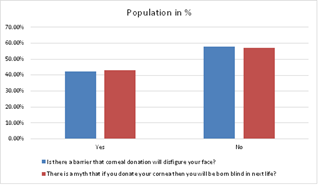
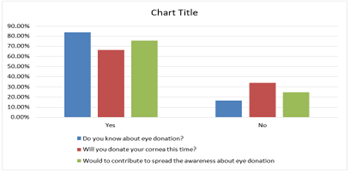
Results: 83.7% of the population were aware of eye donation, of whom 45.9% were unsure about the ideal time for corneal donation after death. 75.5% were willing to help spread awareness about corneal/eye donation, though a lack of knowledge was found even among younger respondents. 42.9% of the population still believed the myth that donating a cornea would leave them blind in a future life, and 42.3% believed it would disfigure the face.
Conclusion: Most respondents were aware of eye donation and were willing to help spread awareness and to contribute their own eyes, but a portion of the population still lacked basic knowledge and held on to myths. Continued efforts through camps and other outreach programs are needed to bring vision back to the lives of the visually impaired.
Keywords: eye donation: eye bank; awareness; corneal blindness; corneal transplantation
Introduction
Vision is one of the most vital senses that enables individuals to interact with the world. Unfortunately, millions of people suffer from visual impairment or corneal blindness, which severely affects their quality of life. Among the various causes of blindness, corneal diseases are a significant contributor, especially in developing countries like India. Corneal transplantation remains the only effective treatment for restoring vision in such cases. However, the availability of donor corneas is critically low, resulting in a widening gap between demand and supply.
Eye donation is a noble act that can bring light into the lives of two blind individuals. Despite numerous awareness campaigns and national programs, the rate of eye donation in India remains suboptimal. A major reason for this is the lack of awareness and prevalent misconceptions among the general population, particularly in rural and semi-urban areas.
Tehri Garhwal, a hilly district in Uttarakhand, represents a region where healthcare awareness and access remain limited. The level of awareness regarding eye donation among the non-medical population in such areas is crucial to enhancing donation rates and supporting eye banking efforts.
This study aims to assess the awareness, knowledge, and attitudes towards eye donation among the non-medical population in Tehri Garhwal. By identifying the existing gaps and barriers, this research intends to provide insights that can help formulate effective community-based strategies to promote eye donation in this region.
Though every organ of the body is equally significant, the eyes hold a special place: they give us vision and let us appreciate the beauty the world has to offer. Yet, due to various forms of visual impairment, many people lose their sight and the world turns dark for them. A simple act of eye donation can give them back the gift of light.
Blindness is a significant global concern. According to the WHO, after cataract and glaucoma, corneal disorders are a leading cause of blindness. Most of these are treatable, especially through eye donation — the donation of one's eyes after death. Like any other organ, the cornea can be donated after death to restore vision to the sightless. Yet, due to a lack of awareness and social or religious reservations, eye donation has still not received the importance it deserves in our country.
To raise awareness on eye donation, the National Eye Donation Fortnight is observed every year from August 25 to September 8. Donated eyes are used to restore vision in people suffering from corneal blindness, most commonly through a surgical procedure called keratoplasty, in which the cornea is replaced. At present, there is no alternative treatment for corneal blindness other than corneal transplantation. Eye donation is truly a noble deed — there can be no greater gift than giving someone the ability to see the world in color. However, many misconceptions still stand in the way of this act, and it is important that these myths surrounding eye donation be addressed so that awareness can spread.
Materials and Methods
Study Design
This study was a cross-sectional survey conducted to assess awareness regarding eye donation among the non-medical population in Tehri Garhwal. The study was based on a structured questionnaire adapted from previously published research (with due permission from the original author).
Study Area and Duration
The study was conducted in Tehri Garhwal, Uttarakhand, over a period of one year, from July 2023 to July 2024.
Sampling Method
A convenience sampling technique was used to recruit participants from the target population.
Sample Size
A total of 300 participants were included in the study.
Study Population and Eligibility Criteria
Inclusion criteria: Individuals aged 20 to 55 years; residents of Tehri Garhwal with no retinal disease or corneal opacities; only individuals of Indian nationality were included.
Exclusion criteria: Individuals below 20 or above 55 years of age; individuals with mental illness; individuals with retinal disease or corneal opacities.
Data Collection Tool and Procedure
A structured questionnaire adapted from previously validated research was used for data collection. It comprised two sections: demographic details (age, gender, education, etc.) and questions on awareness, knowledge, and attitude toward eye donation. The questionnaire was distributed digitally via email and WhatsApp to eligible participants, and informed consent was obtained electronically before participation.
Results
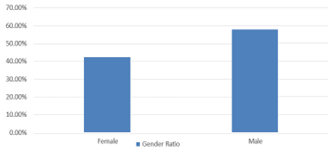
Of the 300 participants, 42.2% were women and 57.8% were men. 83.7% of the population were aware of eye donation, and 54.1% were unsure about the ideal time to pledge corneas after death. 74.8% knew that only the corneas are removed after death, and 50.7% knew where to register for eye donation. 72.1% were willing to donate their own eyes, and 75.5% wanted to contribute to spreading awareness about eye donation. However, 42.3% of the population still believed the myth that donation would disfigure the face, and 16.3% had no idea about eye donation at all. This bar graph shows the gender ratio.
This bar graph is showing the percentage of population who are believe in myths about eye donation.
This bar graph shows the percentage about the population who have a good knowledge about eye donation.
Gender distribution of respondents
Table 1: Gender ratio of study participants.
| Gender | Percentage |
| Male | 57.8% |
| Female | 42.2% |
Ethical Considerations
Ethical approval was obtained from the relevant institutional committee prior to the study. Permission to use the questionnaire was obtained from the original author. Participants were assured of confidentiality, and data was collected and used anonymously for research purposes only.
Discussion
In this study, among 300 subjects, 83.7% of the population were aware of eye donation while 16.3% had no idea about it. In India, the number of donors remains far lower than the demand for corneal transplants. Eye donation is a noble deed, and further awareness should be generated through camps and other outreach activities, especially in rural areas. Awareness and willingness to donate were found to be lower among women than men, indicating a need for targeted efforts to highlight the significance of eye donation and to dispel prevailing myths among this group.
Future Directions
Future research on eye donation awareness can focus on expanding the study to include larger and more diverse populations across different regions of India to improve generalizability. Interventional studies could also assess the effectiveness of targeted awareness campaigns delivered through social media, community outreach, and educational programs. Further qualitative research exploring the psychological and cultural barriers to eye donation could provide richer insight for designing more impactful strategies, and involving local healthcare workers and schools may help strengthen awareness at the grassroots level.
Conclusion
This study found that awareness of eye donation among the non-medical population of Tehri Garhwal was generally good, though a portion of the population — particularly those aged 40–50 years — remained unaware. To spread awareness further, camps and outreach programs should be organized in settings such as factories, schools, and seminars. Most respondents were willing to donate their eyes and to help spread awareness, but a segment of the population remains reluctant due to persisting myths.
References
- Acharya, M., Farooqui, J. H., Dave, A., Chaku, D., Ganguli, K. K., Das, A., & Mathur, U. (2019). Eye donation in North India—Trends, awareness, influence and barriers.
Publisher | Google Scholor - Krishnaiah, S., Kovai, V., Nutheti, R., Shamanna, B. R., Thomas, R., & Rao, G. N. (2004). Awareness of eye donation in the rural population of India. Indian Journal of Ophthalmology, 52(1):73–78.
Publisher | Google Scholor - Runda, N., Ganger, A., Gupta, N., Vashist, P., Singh, A., & Tandon, R. (n.d.). Knowledge and attitude towards eye donation among health professionals of North India.
Publisher | Google Scholor - Dave, A., Patel, N. V., Acharya, M., Chaku, D., Das, A., Mathur, U., & Biswas, S. (n.d.). Awareness regarding eye donation among staff of a tertiary eye care hospital in North India.
Publisher | Google Scholor - Bharti, M. K., Reddy, S. C., Tajunisah, I., & Ali, N. A. M. (n.d.). Awareness and knowledge on eye donation among university students.
Publisher | Google Scholor - Biswas, J., Bandyopadhyay, S., Das, D., Mondal, K. K., Saha, I., & Ray, B. (2010). A study on awareness about eye health care and eye donation among secondary level students of North Kolkata, India. Kathmandu University Medical Journal, 8(31):317–320.
Publisher | Google Scholor - Pallerla, S. R., Khanna, R. C., Krishnaiah, S., & Keeffe, J. (2022). Eye donation: Awareness, knowledge and willingness among general public in Southern Indian population. International Journal of Community Medicine and Public Health, 9(6):2474–2478.
Publisher | Google Scholor - Krishnaiah, S., Kovai, V., Nutheti, R., Shamanna, B. R., Thomas, R., & Rao, G. N. (2004). Awareness of eye donation in the rural population of India. Indian Journal of Ophthalmology, 52(1):73–78.
Publisher | Google Scholor - Tiwari, R., Diwakar, A., Marskole, P., Bhargo, L., & Anwar, D. (2017). A study to assess awareness on eye donation and willingness to pledge eyes for donation in adult population in Gwalior district (M.P.). International Journal of Research in Medical Sciences, 2(2):662–666.
Publisher | Google Scholor - Maiya, G. R., Kiran, K. G., & Badiger, S. (2018). Assessment of awareness and perception regarding eye donation among selected patients attending field practice area of a tertiary care hospital in Mangalore: A cross-sectional study. International Journal of Community Medicine and Public Health, 5(7):2920–2925.
Publisher | Google Scholor - Biswas, J., Bandyopadhyay, S., Das, D., Mondal, K. K., Saha, I., & Ray, B. (2010). A study on awareness about eye health care and eye donation among secondary level students of North Kolkata, India. Kathmandu University Medical Journal, 8(31):317–320.
Publisher | Google Scholor - Patel, P. G., Brahme, K. M., Shringarpure, K. S., & Bhatt, R. (2019). Knowledge, attitude and practice related to eye donation among donors' and recipients' family in Ahmedabad: A cross-sectional study. International Journal of Community Medicine and Public Health, 6(12):5032–5036.
Publisher | Google Scholor