
Research Article
The Effect of Sleep Quality on Examination Scores of First Year Osteopathic Medical Students
- Younis Sutari *
- Sultan Akbar
- Zaid Mateen
A.T. Still University - School of Osteopathic Medicine in Arizona (ATSU-SOMA), USA.
*Corresponding Author: Younis Sutari, A.T. Still University - School of Osteopathic Medicine in Arizona (ATSU-SOMA), USA.
Citation: Sutari Y, Akbar S, Mateen Z. (2025). The Effect of Sleep Quality on Examination Scores of First Year Osteopathic Medical Students, International Clinical Case Reports and Reviews, BioRes Scientia Publishers. 3(3):1-3. DOI: 10.59657/2993-0855.brs.25.040
Copyright: © 2025 Younis Sutari, this is an open-access article distributed under the terms of the Creative Commons Attribution License, which permits unrestricted use, distribution, and reproduction in any medium, provided the original author and source are credited.
Received: March 27, 2025 | Accepted: April 16, 2025 | Published: April 21, 2025
Abstract
Medical students frequently encounter high levels of stress and pressure, which can negatively affect their mental health and sleep quality, a key determinant of cognitive function and academic success. This study assesses the relationship between sleep effectiveness and academic performance among medical students. An observational, cross-sectional survey took place at A.T. Still University - School of Osteopathic Medicine in Arizona (ATSU-SOMA), involving participants from the 2027 cohort. The Pittsburgh Sleep Quality Index (PSQI) questionnaire was used and exam scores from the second exam of the fourth block were analyzed. For the purpose of our inquiry, the PSQI was used for our analysis.
The results indicated a significant inverse relationship between sleep quality and exam performance (R² = 0.087, p = 0.013), demonstrating that decreased sleep quality was associated with lower exam performance. The study underscores the detrimental effects of insufficient sleep on medical students' cognitive abilities, particularly during periods of high academic demand.
This research also suggests that academic performance is best explained by multiple variables rather than simply one. Future studies should investigate the long-term effects of sleep deprivation and explore interventions beyond sleep hygiene, including stress and time management strategies. Understanding the broader impact of sleep on medical education is essential for fostering better outcomes for students in both academic and clinical settings.
Keywords: academic performance; medical education; memory consolidation; sleep timing; sleep quality
Introduction
Medical students face an immense amount of stress and pressure throughout their education and clinical training, which can significantly impact their mental health, particularly their sleep quality. Sleep is a fundamental human necessity, on par with eating, breathing, and other basic physiological needs [1,6]. Sufficient sleep—typically 7 to 8 hours for most adults—is crucial for maintaining physical and mental health. Lack of adequate sleep can lead to various negative consequences, including fatigue, difficulty concentrating, impaired cognitive function, and ultimately diminished academic performance [5]. These effects are particularly concerning for medical students who are often required to engage in extended study sessions, especially in their preclinical years, which can disrupt their sleep patterns and quality [1].
Sleep plays a vital role in memory consolidation and cognitive restoration. A meta-analysis of seventy studies confirmed that acute sleep deprivation significantly impairs cognitive functions such as attention, working memory, and short-term memory [2]. Moreover, research highlights that sleep is crucial for maintaining working memory capacity, a key component of academic success. During the highly demanding period of medical school, many students struggle with poor sleep quality, insufficient sleep duration, and irregular sleep-wake schedules, all of which can harm their learning and memory performance [3,4]. Despite being in one of the most learning-intensive phases, medical students often do not meet their sleep needs, posing risks to their academic achievements and overall well-being [3].
Methods
This observational, cross-sectional survey was conducted at A.T. Still University - School of Osteopathic Medicine in Arizona (ATSU-SOMA) to assess the relationship between sleep habits and academic performance. The study focused on the second exam of the fourth block, which took place on May 23, 2024. The survey remained open for seven days, concluding on May 31, 2024. Participants included 46 students from the 2027 cohort class. The exam scores were verified and participants de-identified by a FERPA adhering faculty member not directly involved with the project.
Data were collected using the Pittsburgh Sleep Quality Index (PSQI), administered through a Qualtrics survey. In addition to the PSQI, students responded to supplementary questions about their beliefs and perceptions about sleep. All participants provided informed consent, and the study received approval from the Institutional Review Board (IRB). The survey also included evaluating students' academic performance based on their exam results.
The data was analyzed using an r2 for linear reg and the p-value was computed through a two-tailed T-test. Descriptive statistics were generated for each question to summarize student responses and identify trends or patterns.
Results
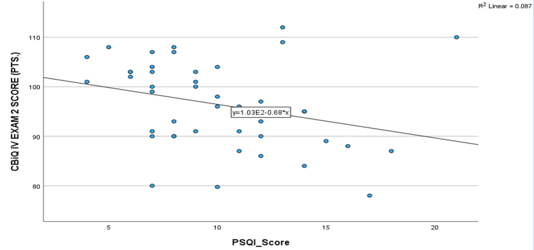
Figure 1: CBIQ IV Exam II Score vs PSQI
The above figure (Figure 1) shows a scatter plot attempting to express the variability in participants’ CBIQ IV Exam II scores regarding their PSQIs. A linear regression was then performed and overlaid on the scatter plot (R²=0.087). Subsequently, a two-tailed T-test was performed (p=0.013).
Analysis
With a higher PSQI value correlating to a lower quality of sleep, it is crucial to establish that the greater the sleep quality, the worse the exam score. Following our statistical analysis, our linear regression indicated a negative correlation between the CBIQ IV Exam II score and PSQI. Our supported the initial hypothesis that poorer sleep effectiveness was associated with decreased exam performance. The results of the two-tailed T-test showed that the variation in CBIQ IV Exam II scores inversely correlated with PSQI, reaching statistical significance (p = 0.013).
Conclusion
Addressing sleep deprivation among medical students may require strategies beyond improving sleep quality or duration. Further research should explore the long-term consequences of poor sleep behaviors on overall academic performance and mental health while investigating other contributing factors such as stress management, time management, and lifestyle interventions. Since the results contradicted the hypothesis which was initially made, further studies need to be conducted in terms of controlling and manipulating other variables such as personal academic goals, whether or not the lack of sleep was a result of studying more, and the amount of previous knowledge that each person had on the exam’s subject. Additionally, there is significant intraspecific variation with the differences of sleep needs from person to person. Qualitative studies could provide deeper insights into the subjective experiences of medical students regarding their sleep and academic performance. While maintaining sufficient sleep is fundamental for cognitive function, this study highlights the diverse array of other factors that play important roles in academic achievement. Further research is essential to understand how medical education and clinical demands affect sleep and how these sleep patterns impact long-term educational outcomes and student well-being.
Declarations
Disclosure of conflict of interest
No conflict of interest to be disclosed.
Statement of informed consent
Informed consent was obtained from all individual participants included in the study.
IRB form attached
Acknowledgements
Anna Campbell, PhD (A.T. Still University - School of Osteopathic Medicine in Arizona (ATSU-SOMA))
References
- Al Ani HM, Al Shawi AF, Lafta RK, Abdulqadir O, Nadhim S, Abdulkarim S. (2024). Influence of stress, anxiety, and depression on sleep quality and academic performance of medical students in Fallujah University, Iraq. The International Journal of Social Psychiatry, 70(4):772-777.
Publisher | Google Scholor - Alotaibi AD, Alosaimi FM, Alajlan AA, Bin Abdulrahman KA. (2020). The relationship between sleep quality, stress, and academic performance among medical students. Journal of Family & Community Medicine, 27(1):23-28.
Publisher | Google Scholor - Curcio, Giuseppe, et al. (2006).
Publisher | Google Scholor - Diekelmann S, Born J. (2010). The memory function of sleep. Nature Reviews Neuroscience, 11(2):114-126.
Publisher | Google Scholor - Dyrbye LN, Thomas MR, Massie FS, Power DV, Eacker A, Harper W, et al. (2008). Burnout and Suicidal Ideation among U.S. Medical Students. Annals of Internal Medicine, 149(5):334.
Publisher | Google Scholor - Nsengimana A, Mugabo E, Niyonsenga J, Hategekimana JC, Biracyaza E, Mutarambirwa R, et al. (2023). Sleep quality among undergraduate medical students in Rwanda: a comparative study. Scientific Reports, 13(1):265.
Publisher | Google Scholor